


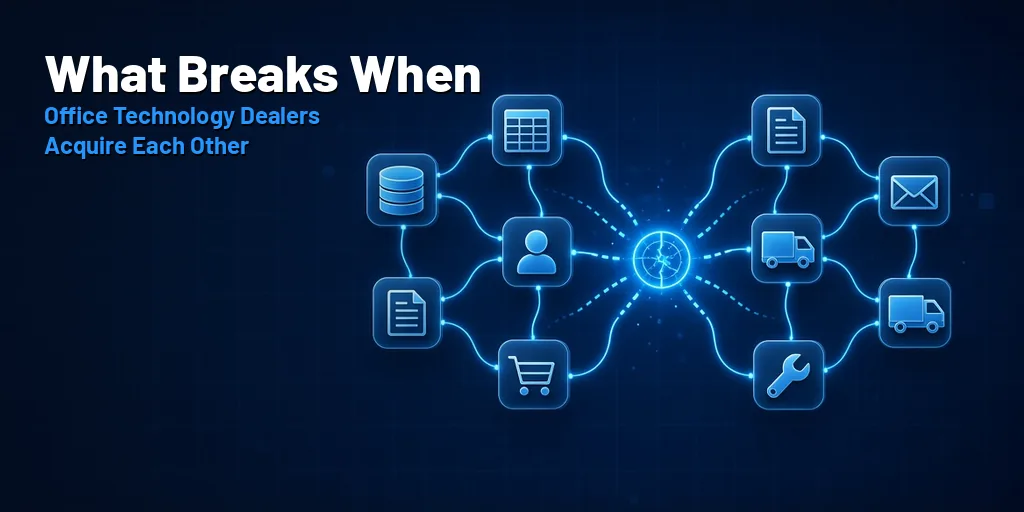
Nearly half of office technology dealers say they plan to buy another dealership or service company. The purchase agreement is not the hard part. The hard part starts about 90 days after close: two customer files, two serial histories, two dispatch boards, and two item masters are still running while customers expect the same technician tomorrow.
Not the least of these challenges is the daunting task of integrating two businesses’ systems into a single management point of truth, efficiency, and execution. But there are other obstacles along the way that even the most discerning business executive may overlook.
Office Technology and Equipment Dealer Acquisitions
This isn’t hypothetical. It is happening. Examples include Pacific Office Automation, Datamax, Novatech (from ENX 2025–26 deal coverage), and there are many more. In fact, nearly half of surveyed dealers say they plan to buy another shop. But the deal is usually the easy part. The difficulties typically arise some 90 days after the deal closes. You are now struggling to manage two customer files, differing serial-number histories, two dispatch boards, varied item masters, and customers who still expect the same technician and support they have come to expect.
So whether you are buying a copier dealership, making an office equipment dealer acquisition, or even integrating two service organizations, it is important to understand what to look for to ensure success. Additionally, if your dealer business is potentially considering being acquired in the future, positioning your company to take into account these details will be very helpful.
First, let’s take a look at the current market
Why Office Technology Dealers Are Still Buying Each Other
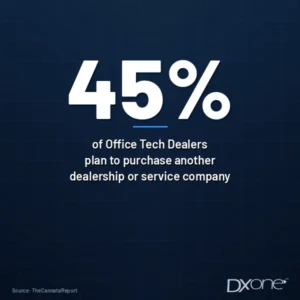

The Cannata Report: 40th Annual Office Technology Dealer Survey (Cannata, Oct 2025): 45% (187 of 415) planned to buy a dealership or service company in 2025 and beyond.
In the same report: “Causes of Concern”: after market/product pressure, talent acquisition, retention, and an aging workforce ranked as a top long-term worry — recruiting younger people into sales and service. Consolidation and AI sit in the uncertainty bucket. That is the people risk inside every deal.
Keypoint Intelligence, Mar 2026. office equipment dealers held 43% of ~$18B 2025 document-imaging revenue; OED share forecast to 40% by 2029 as industry revenue slips toward $17B. Scale via acquisition is how many dealers offset a shrinking pie. That is why scale-by-acquisition is happening.
Challenges After Dealer Acquisition – A Post-Close Operating Guide
As is often the case with complicated business transactions, the hard part begins AFTER the deal closes. Dealer M&A integration is one of the more challenging components, often not well thought out during negotiations and due diligence phases. But there are others. Let’s touch on a few that you should consider early in acquisition discussions.
A CIO.com contributor piece citing KPMG, Mastering Complex Deals and Integration, 2024, notes that misaligned data models such as customers, products, vendors, and reporting systems are among the largest integration failures in these scenarios. Undocumented and customized code, scripts, and side integrations tend to surface later on, causing tremendous obstacles to a smooth integration.
Here are the five things that tend to break first:
- Customer/serial data
- Contract and meter history
- Parts catalogs
- Dispatch/territory rules
- Technician culture
Day 1 vs Day 100: what must stay live
Though there will inevitably be many other challenges facing a merger of culture, systems, and processes, there are a few main items that will need immediate focus to keep things moving. These include priorities for what must stay live and working through any transitional changes. This covers things such as service tickets, parts, and billing. So identifying what can wait, like brand changes, websites, full financial mergers, and others, needs to be identified and planned for after the priorities have been addressed.
To overcome many merger obstacles, it would be wise to adopt a One-system rule: Cherry-picking “the best screens and systems from one or the other ERP” is how integrations stall or fail, even years later. Researching the right system to support the acquisition and merger of both companies will be crucial to the expedient success of the purchase. An Open Architecture ERP for Office Tech Dealers is a good place to start.
A practical 30/60/90 checklist should be created that covers some or all of the following items:
- Freeze item-number changes — colliding SKUs in week one is how vans get the wrong part.
- Map serials before you merge billing — meter-to-invoice breaks if the acquired serial is not in the surviving asset file.
- Pick one surviving chart of accounts — two books after Day 100 means you cannot see whether the deal is earning out.
- Keep SLAs visible on both dispatch boards until one board is live.
- Do not re-badge the truck on Monday — culture and customer recognition break before the logo does.
Things to Consider In A Merger/Acquisition Within The Dealer Channel
The one-system rule
FTI Consulting on 2026 deal integration: the instinct to cherry-pick features from each stack is the principle teams violate most often. Cleanest outcomes pick one platform per function early and migrate; mixing ERPs “consumes years.”
How to tell if the acquisition worked
- Customer retention increases
- Response times improve
- First-visit closes
- Recurring revenue growth, not just location count.
A dealer acquisition is not won at the signing table. It is won when the acquired customer still gets a tech on time, the invoice still matches the meter, and the parts bin still has the right kit, while two companies become one set of books. Most deals stall in data and systems, not in intent. This is why ERP Modernization Matters More Than Ever, and deciding on that evolution is crucial to a surviving operating backbone before Day 1. You will need it to keep service continuous while you migrate serials, contracts, and process flow. Finally, judge success by retention and response time rather than by how many logos you added. If those numbers hold for two quarters, the purchase price has a chance to earn itself and beyond.