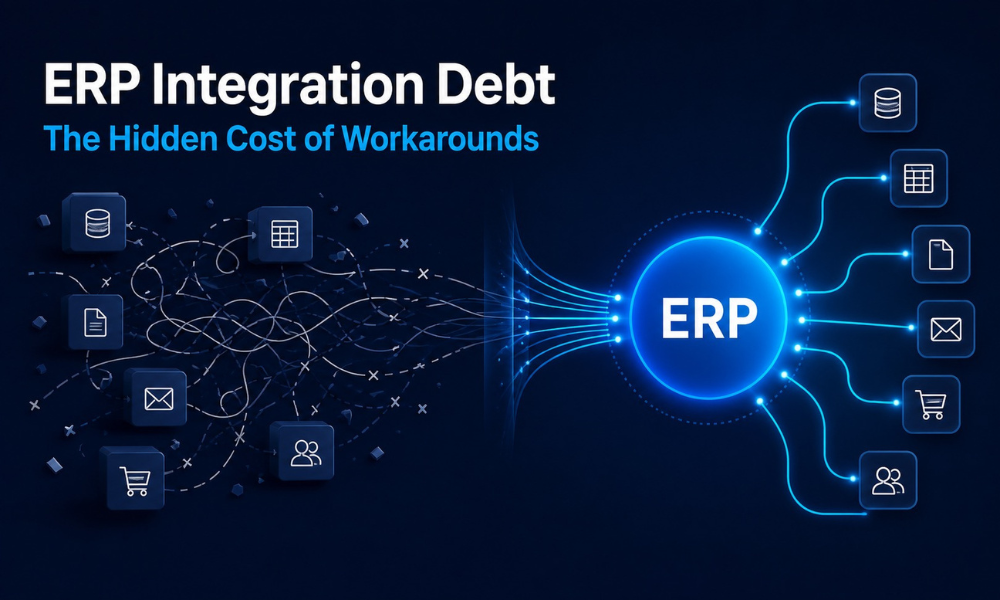
ERP integration debt rarely starts as a major technology failure. It usually starts as a practical decision. A team needs a report. A customer order must move faster. A billing file needs cleanup. A spreadsheet or quick connector solves the immediate problem.
That is how the debt begins.
At first, these workarounds feel useful. They keep the business moving. They help teams avoid delays. They give people a way to handle exceptions when systems do not fully connect. The problem is not the first workaround. The problem is when every workaround becomes permanent infrastructure.
What Is ERP Integration Debt?
ERP integration debt is the hidden cost created by disconnected systems, manual handoffs, fragile connectors, duplicate data, and undocumented workflows. It grows when companies add tools faster than they build integration discipline. Over time, the business depends on processes that were never designed to scale.
This debt can sit between ERP and CRM, eCommerce, billing, device intelligence, service dispatch, inventory, customer portals, reporting tools, or warehouse systems. It can also live inside spreadsheets, scripts, file imports, and manual exports. In many companies, humans become the middleware.
For CTOs, integration debt becomes an architecture problem. For CEOs, it becomes a margin problem. For business users, it becomes daily friction. For customers, it appears as slower service, inconsistent information, billing errors, or unclear order status.
Why Workarounds Feel Harmless At First
Most workarounds begin with good intentions. A department has a problem, IT is busy, and the business cannot wait. Someone builds a spreadsheet, creates a report, exports a file, or writes a script. The fix works well enough, so it stays.
That is understandable.
Modern businesses move fast. No team wants to delay revenue or customer support because of a missing integration. In many cases, the short-term fix is reasonable. The risk appears later, after the company starts relying on that fix every day.
The original owner changes roles. The script stops running. A field changes in ERP. A report breaks during close. No one remembers why the workaround exists. Suddenly, a simple fix becomes a business-critical dependency with no clear owner.
Why ERP Integration Debt Is Becoming A Business Risk
ERP has changed from a back-office system into an operational control plane. It now connects finance, service, sales, inventory, billing, customer experience, automation, analytics, and AI. That broader role makes integration quality much more important. 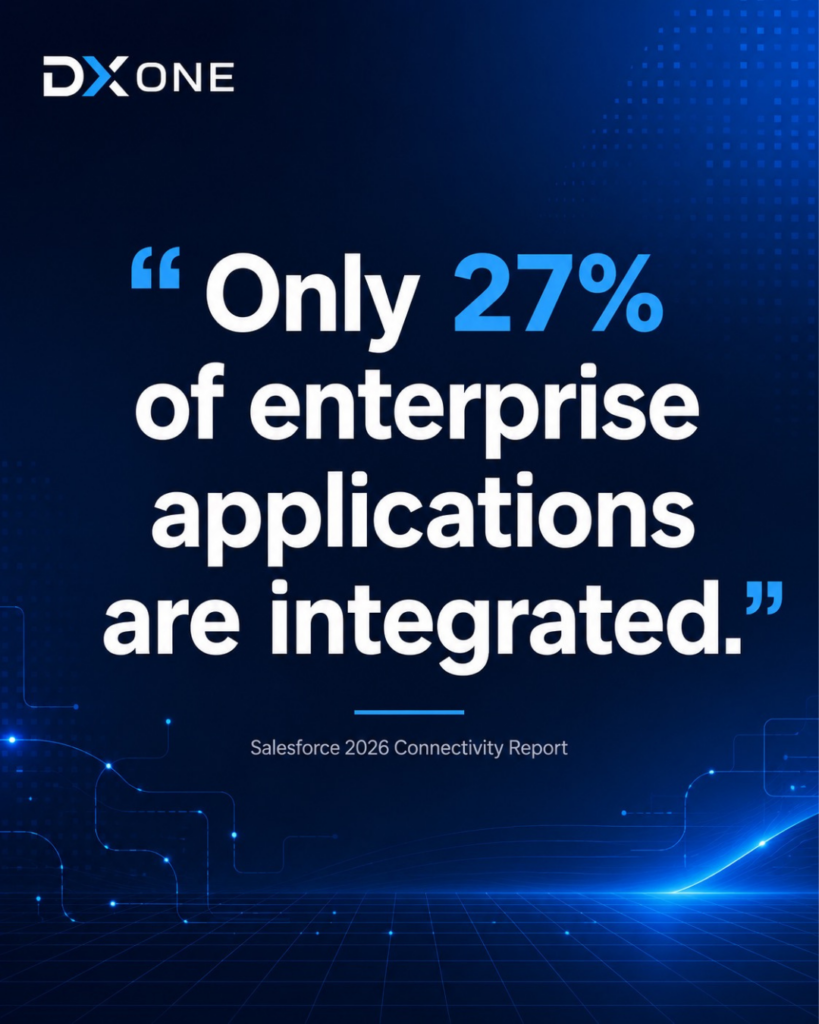
Salesforce’s 2026 Connectivity Report found that enterprise application portfolios grew from 897 apps to 957 apps year over year. Yet only 27% of those applications are integrated. The report also found that 86% of IT leaders worry AI agents will create more complexity than value without proper integration.
That is the integration debt problem in plain language. Companies have more systems, more data, and more automation goals. But many workflows still depend on disconnected applications. This creates a growing gap between executive expectations and technical reality.
The Hidden Cost Of Fragmented Systems
Disconnected systems create real financial damage. TechRadar reported that businesses lost an average of $104 million last year due to digital inefficiencies. The article connected those losses to fragmented technology environments and poor integration across workplace systems.
Most dealers will not see a $104 million loss. That figure reflects large organizations. However, the pattern applies at every size. Disconnected systems force people to search, re-enter, validate, correct, reconcile, and move information manually.
Those tasks create hidden costs. They show up in payroll, delayed billing, missed revenue, slow service response, customer credits, and reporting cleanup. The costs may not appear as one invoice. However, they still reduce profitability.
Integration Debt Is More Than Technical Debt
Technical debt usually describes shortcuts in code, infrastructure, or system architecture. ERP integration debt is broader. It includes business process debt, data governance debt, workflow debt, reporting debt, and customer experience debt.
A custom integration can be technically stable and still create integration debt. That happens when it connects the wrong data fields, lacks monitoring, skips governance, or depends on one person to maintain it. Stability alone does not make an integration healthy.
A spreadsheet can also create integration debt. So can a daily CSV import. So can a billing process where someone copies eCommerce orders into ERP. The issue is not the tool. The issue is whether the process is fragile, manual, undocumented, or hard to scale.
Where ERP Integration Debt Hides
Integration debt often hides in normal business routines. It hides in reports that only one person knows how to create. It hides in nightly imports no one monitors. It hides in spreadsheets used to clean ERP data before month-end.
It also hides in customer-facing workflows. A customer places an order through a portal. The experience looks digital. Behind the scenes, a team checks pricing, confirms inventory, enters the order again, and manually triggers billing.
The customer sees convenience. The business absorbs complexity. That gap matters because a modern front-end experience can still create back-office friction. When volume increases, those manual steps become harder to sustain.
The ERP Integration Debt Cycle
Integration debt usually follows a predictable cycle. A team adds a new application. The application needs ERP data. IT builds a quick connection or manual process. The process works. More people begin using it.
Then exceptions appear. A customer has special pricing. A contract has unique billing terms. A device alert needs to trigger service. A payment update should flow to the customer portal. Each exception adds new logic.
Over time, the workaround becomes part of the operating model. Later, leadership asks for real-time reporting, AI automation, or cleaner billing. The team discovers that the workflow cannot support those goals without major cleanup.
Why CEOs Should Treat ERP Integration Debt As A Growth Risk
ERP integration debt directly affects business performance. It slows billing, delays reporting, creates customer friction, increases manual labor, and reduces confidence in business data. It can also make growth more expensive than expected.
A company can win new customers and still struggle to profit from that growth. This happens when every new account creates extra manual work across service, billing, inventory, finance, and support. Revenue rises, but operating complexity rises with it.
CEOs do not need to know every API detail. They do need to know whether the company can scale without adding unnecessary headcount. Integration debt determines whether growth creates leverage or simply creates more work.
Why CTOs Should Treat ERP Integration Debt As An Architecture Risk
For CTOs, integration debt becomes an architecture and reliability risk. It increases system complexity, makes change harder, and raises the chance that small updates break critical workflows. It also slows IT delivery.
Technology teams often spend too much time maintaining fragile connections. They resolve repetitive tickets, troubleshoot failed syncs, patch old scripts, and avoid touching integrations nobody fully understands. This keeps the lights on, but it slows modernization.
A CTO does not need to eliminate every workaround immediately. That would be unrealistic. The more practical goal is visibility. Leaders need to know which integrations are critical, which are risky, and which should be retired first.
How ERP Integration Debt Creates Daily Friction For Business Teams
Business teams experience integration debt as friction. Sales teams may not trust customer data. Finance may chase billing exceptions. Service teams may work from outdated tickets. Operations may reconcile inventory by hand.
These problems create habits. People build private spreadsheets. They keep their own lists. They send screenshots. They copy details between systems. Each workaround feels necessary because the official workflow does not fully support the job.
Eventually, the unofficial process becomes stronger than the official process. That is dangerous. When people stop trusting ERP data, decisions become slower, reporting becomes harder, and accountability becomes less clear.
How Integration Debt Hurts Reporting
Reporting often exposes integration debt first. A dashboard shows one number. ERP shows another. A spreadsheet shows a third. The team then spends hours explaining which number is correct.
This is usually not a dashboard problem. It is a data flow problem. Reports are only as reliable as the processes behind them. If orders, service tickets, invoices, inventory, and customer records move through disconnected workflows, reporting will require cleanup.
Real-time reporting becomes especially difficult. Batch imports and manual updates create timing gaps. A report may be technically accurate, but still too late to guide action. Leaders need reporting they can trust while decisions still matter.
How Integration Debt Hurts Customer Experience
Customers rarely see integration debt directly. They feel it through outcomes. They notice unclear order status, billing errors, repeated questions, slow service updates, and support teams that lack context.
A business may think it has a customer experience problem. In reality, it may have a system connectivity problem. Customer-facing employees cannot provide smooth service when data is trapped across disconnected systems.
This matters more as buyers expect digital convenience. A customer portal means little if the data is stale. A fast online order means little if fulfillment depends on manual cleanup. Connected workflows create customer confidence.
How Integration Debt Hurts Billing
Billing is one of the most expensive places for ERP integration debt. Invoices depend on customer records, contract terms, pricing, taxes, product data, service activity, usage data, approvals, and delivery status.
When those inputs live across disconnected systems, billing becomes exception-heavy. Finance teams review, adjust, verify, and reconcile. This delays invoices, slows cash flow, and increases the chance of customer disputes.
Dealers often feel this pain through managed services, subscriptions, equipment, supplies, usage-based billing, and service contracts. A modern ERP should reduce billing friction. Integration debt does the opposite.
How Integration Debt Hurts Service Operations
Service operations depend on timing. A device alert may need to create a service call. Dispatch may need technician availability. A technician may need parts data. Billing may need completion details after the work is done.
When service systems and ERP do not communicate, teams fill the gaps manually. They check multiple systems, copy notes, call other departments, and update records later. These steps slow service and reduce visibility.
The bigger issue is profitability. If technician time, parts, contract terms, device history, and invoices do not connect, leaders cannot easily see service margin. Integration debt hides operational truth.
How Integration Debt Hurts Inventory
Inventory accuracy depends on connected transactions. Orders, receipts, returns, warehouse moves, service parts, customer shipments, and purchasing activity all affect availability. If these updates happen in separate systems, teams lose confidence.
That creates bad decisions. Sales may promise products that are not available. Service may schedule work without required parts. Purchasing may reorder too late or too early. Warehouse teams may rely on manual counts to verify system data.
The ERP may be accurate after reconciliation. However, the business needs accuracy during the workflow. Real-time operations require real-time inventory movement, not delayed correction.
How Integration Debt Blocks AI
AI makes integration debt more urgent. AI tools need accurate, timely, governed, and accessible data. If data is scattered across disconnected systems, AI recommendations become weaker. Automation also becomes riskier.
Confluent’s 2026 Data Streaming Report found that 72% of global IT leaders say a lack of real-time data infrastructure is stalling AI scaling efforts. It also found that 66% cite uncertainty around data lineage, timeliness, and quality as a common challenge.
This is why many companies do not have an AI investment problem. They have a data readiness problem. ERP integration debt sits directly inside that problem because AI cannot automate workflows it cannot reliably understand.
Why Agentic AI Raises The Stakes
Agentic AI changes the risk profile. Traditional AI may summarize data or recommend action. Agentic AI may create tickets, route approvals, draft invoices, update records, or trigger workflows across systems.
That requires trustworthy integration. An agent cannot safely act when data is stale, duplicated, or poorly governed. It also cannot explain its decisions if data lineage is unclear.
Reuters reported in July 2026 that Capgemini’s CEO identified legacy systems, fragmented data, and complex technology estates as barriers to AI at scale. He also described a multi-year modernization cycle in data, software, and infrastructure.
Integration Debt And Security Risk
Workarounds often create security blind spots. A spreadsheet may contain sensitive customer data. A script may use shared credentials. A manual export may sit in email. A side database may lack access controls.
Each workaround expands risk. Security teams cannot protect data flows they cannot see. Compliance teams cannot audit processes that are not logged. IT cannot govern integrations created outside formal architecture.
This does not mean every workaround is reckless. It means unmanaged workarounds create exposure. ERP often contains financial, contract, customer, employee, and operational data. That data needs role-based access, audit trails, and clear ownership.
Integration Debt And Compliance
Audit readiness depends on traceability. A business should know where data came from, who changed it, when it changed, and what workflow approved it. Integration debt makes that harder.
Compliance questions become harder to answer. Which system is the source of truth? Was pricing changed manually? Did billing use the correct contract terms? Was access removed after an employee changed roles?
Disconnected workflows do not always mean a company is noncompliant. They do mean evidence takes longer to gather. During audits, disputes, incidents, or customer reviews, that delay becomes expensive.
How ERP Integration Debt Complicates Mergers And Acquisitions
Integration debt becomes painful during acquisitions. A company may buy another business and discover different systems, contract structures, customer records, billing rules, service processes, and reporting logic.
The financial model may look attractive, but operational integration can become complicated. Systems must be mapped. Data must be cleaned. Workflows must be standardized. Reports must be reconciled. Customers must be migrated carefully.
A company with clean integration foundations can absorb acquisitions faster. A company with fragile workarounds must first understand its own internal processes before adding another set of systems.
Integration Debt And Employee Experience
Employees often know where integration debt lives. They know which report takes too long. They know which spreadsheet everyone depends on. They know which system does not match another system.
That knowledge creates stress. People become responsible for holding disconnected systems together. They remember special cases, fix exceptions, chase missing data, and explain delays to customers.
This is not a good use of talent. Skilled employees should not function as manual middleware. They should serve customers, improve workflows, and create value. Integration debt pushes them toward repetitive administrative work.
Why ERP Customization Is Not The Same As Integration Debt
Customization is not automatically bad. Many businesses need industry-specific workflows. Dealers often need contract logic, billing rules, device data, service workflows, supplies management, and customer-specific pricing.
The problem is uncontrolled customization. A good customization is documented, monitored, governed, and aligned with system strategy. It has an owner. It has a business purpose. It can be tested during upgrades.
Integration debt is different. It is usually undocumented, fragile, duplicated, manually maintained, or dependent on tribal knowledge. The goal is not to eliminate customization. The goal is to eliminate unmanaged complexity.
How To Spot ERP Integration Debt Before It Spreads
ERP integration debt becomes easier to manage when leaders can name it. Common signs include repeated manual entry, conflicting reports, duplicate customer records, delayed billing, inconsistent inventory, and reports that require spreadsheet cleanup.
Other symptoms include custom scripts without monitoring, unclear integration ownership, frequent sync failures, API sprawl, and business users who maintain private tracking files. These are not minor annoyances. They are signals that the operating model is carrying hidden debt.
Useful warning signs include:
- Teams export data daily to complete work
- Employees re-enter orders into ERP
- Billing depends on manual reconciliation
- Reports show conflicting numbers
- Customer records differ across systems
- Integrations break after field changes
- Data lineage is unclear
- Employees distrust system information
Each symptom deserves attention. Not every issue requires a major project. Some need cleanup, ownership, or documentation. Others require architecture redesign.
Why Integration Debt Compounds
Integration debt compounds because every workaround creates a dependency. A new report depends on the workaround. A new employee learns the workaround. A new integration connects to the workaround. A new automation must account for it.
Eventually, the workaround becomes architecture. Removing it becomes harder than creating it was. This is why integration debt is so persistent. It creates layers of business logic that are not visible in the main ERP design.
When the company finally modernizes, every hidden dependency must be discovered. That discovery work creates cost and uncertainty. Leaders do not always know what will break when old processes change.
The Strategic Cost Model
ERP integration debt has several cost categories. The first is labor cost. This includes time spent entering data, checking fields, reconciling reports, correcting invoices, and chasing information.
The second is error cost. Incorrect pricing, billing, inventory, or customer data can create credits, disputes, delays, and rework. Some errors also reduce trust.
The third is delay cost. Slow workflows affect cash flow, service response, fulfillment, and decision-making. These costs are harder to see, but they influence margin. The fourth is opportunity cost because IT and business teams lose time maintaining fragile processes.
The fifth is risk cost. Poor governance increases security, compliance, and audit exposure. A strong modernization case should include all five categories, not just software licensing or implementation fees.
How To Quantify Integration Debt
Start with workflows that affect revenue, cost, customer experience, or compliance. Good examples include quote-to-cash, order-to-fulfillment, service-call-to-invoice, contract-to-billing, and device-alert-to-dispatch.
Then measure friction. Count manual touches, systems involved, exceptions per week, reconciliation hours, failed syncs, and delayed invoices. Document the time from workflow trigger to completion.
Next, estimate impact using fully loaded labor costs. Include rework, billing delays, customer credits, escalations, and IT maintenance. The goal is not perfect accounting. The goal is a credible operating picture.
Prioritize Debt By Business Impact
A useful prioritization model should be simple. Score each integration debt item by business impact, risk level, frequency, and modernization effort. Then compare that score against strategic relevance.
A process that runs daily and affects cash flow should rank high. A process that runs quarterly and affects a small internal report may rank lower. Both may matter, but sequencing matters more.
A practical scoring model asks five questions. Does it affect revenue? Does it affect customer experience? Does it affect compliance or security? Does it consume repeated labor? Does it block automation or AI?
Build A System Inventory First
You cannot reduce integration debt without a map. Start by identifying systems connected to ERP. Include official applications, custom databases, portals, reporting tools, scripts, file transfers, and spreadsheets.
Manual workflows matter too. A person copying information from one system to another is still an integration. It is just a human integration, and it may be one of the most expensive connections in the business.
The inventory should include system owner, business owner, data objects, frequency, method, reliability, downstream impact, and current pain points. Do not make this a purely technical exercise. Business users usually know the real workflow.
Classify Integration Patterns
After the inventory, classify each connection. Some integrations are API-based. Some use batch files. Some depend on direct database access. Some are event-driven. Some are manual.
Each pattern carries different risk. Manual entry is slow and error-prone. Batch syncs create timing gaps. Point-to-point integrations become brittle as systems grow. Direct database access can create security and upgrade issues.
Classification helps leaders understand why some fixes are easy and others require strategy. Not every problem can be solved by adding another connector. Some require better architecture and cleaner ownership.
Define The Source Of Truth
Modern ERP integration requires clear data ownership. Customer records, pricing, inventory, contracts, service activity, billing terms, and financial transactions should each have a defined system of record.
That system is not always ERP. A device management platform may own raw telemetry. An eCommerce platform may own browsing behavior. However, ERP should often own financial and operational truth.
The key is clarity. Every critical data object needs an owner, update path, validation rule, and audit model. Without source-of-truth discipline, integration debt returns quickly.
Use APIs As Connective Tissue
APIs create more consistent system access. A modern API strategy lets systems exchange data through governed interfaces instead of fragile workarounds. This supports cleaner integrations, better monitoring, stronger security, and easier upgrades.
Salesforce’s 2026 Connectivity Report found that 94% of IT leaders agree AI agent success will require IT architecture to become more API-driven. The report also found that 96% agree AI agent success depends on seamless data integration across systems.
That applies beyond AI. APIs help ERP communicate with eCommerce, customer portals, service tools, warehouse systems, analytics platforms, and device intelligence sources. APIs are not magic, but they are stronger than hidden scripts and manual exports.
Where Event-Driven Architecture Helps
Some workflows need real-time movement. Event-driven architecture helps when systems must react as work happens. An order is placed. A device sends an alert. Inventory changes. A technician closes a ticket.
Each event can trigger downstream action. This model helps ERP become more responsive. It also supports automation because systems act on current information.
However, event-driven design requires discipline. Events need clear naming, ownership, payload standards, retry logic, observability, and security. Without governance, event streams can create a new form of integration debt.
Middleware Alone Does Not Solve Debt
Integration platforms can help. iPaaS tools and middleware can reduce custom code, centralize connectors, manage transformations, and improve monitoring. They can also speed delivery.
However, middleware does not automatically fix bad workflow design. It can hide problems if the business connects messy data to messy processes through a new platform.
Architecture still matters. Data ownership still matters. Governance still matters. Middleware should support a modernization strategy, not replace one. The question is not whether systems are connected. The question is whether they are connected correctly.
Governance Prevents New Debt
Debt reduction requires governance. That does not mean bureaucracy. It means clear rules that keep integrations reliable, secure, and maintainable.
Good governance answers basic questions. Who owns the integration? Who owns the data? What happens when a field changes? How is access controlled? How are failures monitored? How are exceptions handled?
A new integration should not go live without business ownership, security review, testing, monitoring, and rollback planning. These controls protect the business from fragile growth. As AI and automation expand, governance becomes even more important.
Why ERP Integration Monitoring Is Essential For Reliable Workflows
Integrations need monitoring. A silent failure can be more dangerous than a visible outage. If an order sync fails, a billing file does not run, or a device alert never reaches dispatch, the business may not notice immediately.
Modern integration architecture should include observability. Teams should see integration health, message volume, latency, errors, retries, and failed transactions. Alerts should route to the right owner.
This shifts IT from reactive support to proactive management. It also creates accountability. Integration debt thrives in darkness. Observability brings it into view.
Documentation Reduces Key-Person Risk
Poor documentation multiplies debt. Many companies depend on integrations that only one person understands. That creates key-person risk and slows upgrades, audits, troubleshooting, and onboarding.
Good documentation does not need to be complicated. It should identify purpose, owner, systems, data objects, trigger, frequency, transformation logic, dependencies, credentials, monitoring, and failure handling.
Documentation must stay current. Outdated documentation creates false confidence. Teams should update it during changes, not after emergencies. A connected business should not depend on tribal knowledge.
Integration Debt In Quote-To-Cash
Quote-to-cash often reveals deep integration debt. The process touches CRM, pricing, inventory, contracts, approvals, ERP, fulfillment, billing, and collections.
If any step is disconnected, the workflow slows down. A quote may use outdated pricing. An order may require manual entry. Contract terms may not flow into billing. Inventory may update late.
A clean quote-to-cash process connects customer data, pricing rules, product availability, approvals, order creation, shipment status, invoice generation, and payment tracking. This improves visibility, reduces errors, and shortens cycle time.
Integration Debt In Service-To-Invoice
Service-to-invoice is another high-value workflow. A customer reports an issue. A device sends an alert. Dispatch schedules work. A technician uses parts. The work order closes. Billing follows.
When systems are connected, this process is efficient. When they are disconnected, teams manage exceptions. Technician notes may be incomplete. Parts may not update inventory. Contract coverage may require manual review.
These delays reduce margin and make profitability harder to measure. Leadership needs to know which service activities are profitable, which contracts are underpriced, and which customers require extra support.
Integration Debt In eCommerce
eCommerce can expose integration debt quickly. A storefront may accept orders, but that does not mean the business has connected commerce.
The real test is what happens next. Do orders, pricing, inventory, taxes, customer records, fulfillment, and billing flow cleanly into ERP? If not, online sales create back-office labor.
A customer sees a digital experience. The business handles manual cleanup behind the scenes. Connected eCommerce should reduce manual work. Disconnected eCommerce increases it.
Integration Debt In Device Intelligence
Device intelligence becomes valuable when it triggers action. Devices can produce alerts, usage data, supply levels, fault codes, and performance signals. That data can improve service, dispatch, billing, inventory planning, and customer communication.
But device data must reach the business workflow. If device intelligence sits outside ERP, teams may see alerts without action. They may know something happened, but still need manual steps to create tickets or send supplies.
A connected model turns device signals into operational events. Those events can create service calls, update customer records, inform contract profitability, and improve proactive service.
Integration Debt In BI And Analytics
Business intelligence depends on integrated data. Many companies build reporting layers to compensate for messy systems. They extract data from ERP, CRM, service platforms, billing tools, spreadsheets, and databases.
This may work temporarily, but it can become another debt layer. If source systems remain inconsistent, the BI team becomes responsible for cleaning operational data after the fact.
Modern reporting should reflect clean workflows. It should not hide broken ones. If a dashboard is trusted only after manual reconciliation, the company has integration debt.
Integration Debt In Customer Portals
Customer portals depend on accurate data. Customers expect to see orders, invoices, service status, contracts, supplies, equipment, and account information. That information usually lives across several systems.
A portal can only be as good as its integrations. If data is stale, customers lose trust. If service status is missing, they call support. If invoice data is delayed, finance gets involved.
A disconnected portal creates more questions. A connected portal creates self-service. The difference matters because portals should reduce service burden, not add another layer of confusion.
How To Create A Roadmap For Reducing ERP Integration Debt
ERP integration debt should be reduced in phases. Start with discovery. Map systems, workflows, owners, data objects, and manual handoffs. Find the processes that create the most friction.
Then prioritize by business impact. Focus on workflows with high volume, high revenue impact, high risk, or high customer visibility. Do not start with the most technically interesting problem.
Next, define target architecture. Decide which systems own which data. Decide which integrations should be API-based, event-driven, batch-based, or retired. Decide where monitoring and governance will live.
How To Map ERP Integration Debt In 30 Days
The first month should focus on visibility. Create an integration inventory. Identify manual workflows. Interview business users. Review support tickets. Analyze reporting reconciliation. List custom scripts, file transfers, and duplicate databases.
This phase should stay practical. Look for pain points teams already complain about. Ask where data is copied. Ask which numbers are not trusted. Ask which workflows fail during busy periods.
By the end of 30 days, leadership should have a useful map. It should show systems, workflows, owners, risks, quick wins, and deeper architecture concerns.
How To Prioritize ERP Integration Fixes In 90 Days
The first 90 days should deliver visible improvements. Choose one or two workflows with clear business impact. Good examples include order entry, billing exceptions, service ticket creation, customer data synchronization, or inventory updates.
The goal is not a complete transformation. The goal is momentum. Retire a manual step. Improve a sync. Add monitoring. Clarify ownership. Document an integration. Fix one process that employees feel every week.
Early wins matter because they build trust. They show business teams that integration work is not abstract infrastructure. It directly improves how people work.
How To Build A Long-Term ERP Integration Roadmap
The first year should move from cleanup to architecture. Leadership should establish a target integration model, governance structure, API strategy, monitoring standards, and modernization backlog.
This is where integration debt becomes manageable. Each quarter should retire specific debt and improve a high-value workflow. The roadmap should connect technology work to business outcomes like faster billing, better service response, cleaner reporting, or lower manual effort.
The best programs measure both technical and operational progress. Reduced sync failures matter. So do fewer manual touches, faster invoicing, fewer customer disputes, and improved reporting confidence.
What A Modern Integration Foundation Looks Like
A modern ERP integration foundation has several traits. It defines systems of record, uses governed APIs, supports real-time events where needed, monitors integration health, and documents data ownership.
It also aligns technology decisions with business workflows. Integration should not exist only to move fields between systems. It should help the business move work from trigger to outcome with less friction.
That is the real goal. Clean integration allows ERP to support automation, customer portals, reporting, service workflows, billing accuracy, AI, and scalable growth. It turns ERP into an active operating backbone.
How To Reduce ERP Integration Debt Before It Slows Growth
ERP integration debt is the hidden cost of workarounds. It builds slowly, but it eventually affects speed, margin, customer experience, reporting, security, and AI readiness.
The solution is not to blame teams for practical fixes. Workarounds often kept the business moving. The solution is to stop treating them as invisible.
Modern businesses need connected workflows, governed data, observable integrations, and clear ownership. In 2026, the companies that reduce integration debt will be better positioned for automation, AI, growth, and customer trust.
The question is not whether the debt exists. Most growing companies have some. The real question is whether leadership can see it, measure it, and reduce it before it becomes a bigger operating constraint.