


Enterprise software decisions increasingly revolve around cost control and operational resilience. Traditional ERP systems once required large capital investments in servers, infrastructure, and dedicated IT teams. Today, cloud ERP platforms are changing that model entirely. Businesses are moving core operations to cloud-based ERP systems to reduce infrastructure expenses, simplify IT management, and improve scalability. The financial benefits are measurable, and the operational advantages are becoming even more important.
The Cost Problem with Traditional ERP Infrastructure
Traditional on-premise ERP systems require significant upfront investment. Companies must purchase servers, networking equipment, database licenses, and security infrastructure. Beyond the initial investment, organizations must also maintain hardware, apply updates, manage backups, and monitor performance.
This infrastructure burden creates long-term financial pressure. According to ERP market data published in 2025, organizations implementing ERP systems can spend anywhere from $10,000 to over $1 million depending on size and complexity, making infrastructure decisions critical to long-term cost control.
On-premise deployments also require internal IT specialists to manage upgrades, patch vulnerabilities, and maintain uptime. These responsibilities create ongoing operational costs that are often underestimated during ERP planning.
Cloud ERP Eliminates Hardware and Infrastructure Costs
Cloud ERP dramatically changes the cost structure. Instead of purchasing servers and infrastructure, businesses access ERP functionality through vendor-managed cloud environments. The ERP provider manages hosting, security updates, performance monitoring, and infrastructure scaling.
This approach converts large capital expenditures into predictable operational expenses. Companies no longer need to budget for hardware refresh cycles, data center expansion, or system redundancy infrastructure.
Industry data from 2025 shows that organizations migrating to cloud ERP often report 30–50 percent cost savings during the first year after implementation, largely due to the elimination of hardware and infrastructure expenses.
These savings extend well beyond the first year. Hardware depreciation, maintenance contracts, and backup systems disappear from the IT budget entirely.
Lower Total Cost of Ownership Over Time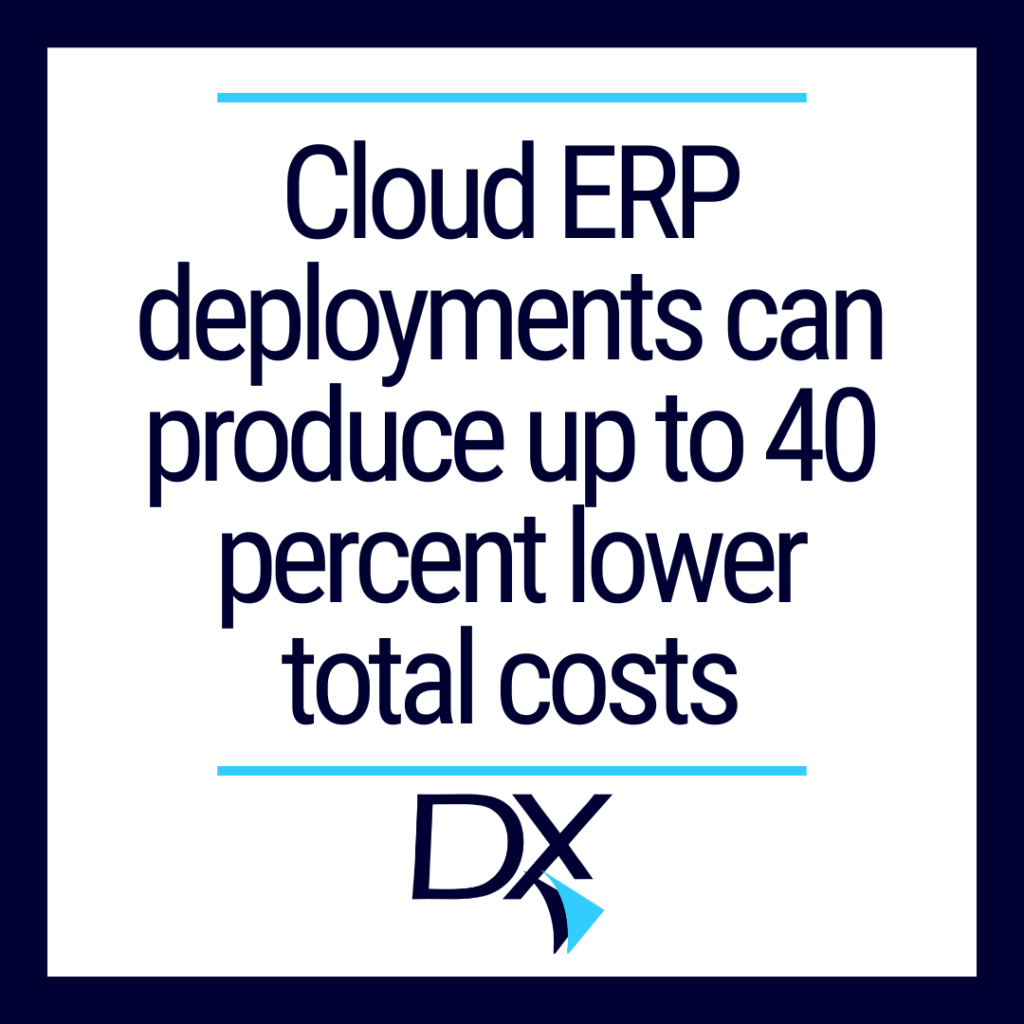

The biggest financial advantage of cloud ERP emerges when organizations evaluate total cost of ownership over several years. On-premise systems may appear cheaper at first because of one-time licensing models. However, maintenance, upgrades, and infrastructure expansion gradually increase long-term costs.
Recent ERP cost analysis published in 2025 found that cloud ERP deployments can produce up to 40 percent lower total costs over five years compared to traditional systems.
Other studies examining long-term ownership show even larger differences. Some industry comparisons show cloud ERP producing 66 percent lower total cost of ownership over ten years when infrastructure, staffing, and upgrade cycles are included.
These numbers demonstrate why so many organizations now evaluate ERP through a lifecycle cost perspective rather than an upfront license price.
Reduced IT Staffing and Operational Complexity
Another significant cost advantage comes from reduced IT workload. Maintaining an on-premise ERP system requires specialists in infrastructure management, database administration, system security, and software patching.
Cloud ERP shifts these responsibilities to the vendor. Updates, security patches, and infrastructure scaling are handled automatically by the provider. Internal IT teams can focus on business innovation instead of maintenance.
This shift reduces the need for specialized ERP administrators and infrastructure engineers. It also eliminates the need for teams to manage backup systems, failover servers, or disaster recovery environments.
For many organizations, the reduction in IT staffing pressure is just as valuable as the direct infrastructure savings.
Faster Deployment and Lower Implementation Risk
Traditional ERP deployments often take a year or longer because of hardware procurement, system configuration, and infrastructure testing. Cloud ERP systems dramatically shorten implementation timelines because the infrastructure already exists.
Organizations can begin deploying applications within weeks rather than months. This faster deployment accelerates time-to-value and reduces implementation risk.
Shorter deployments also reduce consulting costs and project management overhead. Teams can focus on configuration, process improvements, and integrations rather than infrastructure planning.
The result is a smoother ERP rollout with fewer unexpected expenses.
Built-In Security and Compliance Protection
Infrastructure risk is another major concern for ERP leaders. Maintaining secure servers, databases, and backup systems requires continuous monitoring and frequent patching.
Cloud ERP providers operate enterprise-grade security infrastructure that most individual organizations cannot match internally. These platforms typically include encrypted data storage, automated patching, intrusion monitoring, and geographically distributed backups.
Cybersecurity research released in 2025 reported that the average cost of a data breach reached approximately $4.88 million, emphasizing the importance of strong infrastructure protection.
Cloud ERP vendors invest heavily in security systems and compliance certifications to reduce this risk. Businesses benefit from enterprise-level security without needing to build or maintain the infrastructure themselves.
Scalable Infrastructure for Growing Businesses
Another hidden cost of traditional ERP systems is capacity planning. Companies must estimate server requirements years in advance. If demand increases, organizations must purchase new hardware and expand infrastructure.
Cloud ERP platforms solve this problem through elastic scalability. Resources automatically adjust based on workload, user activity, and transaction volume.
This flexibility prevents businesses from over-investing in infrastructure they may not need. It also ensures systems can scale quickly during periods of rapid growth or seasonal demand.
For companies in industries like managed services, distribution, and office technology, this scalability is especially important. As customer bases grow, ERP systems must support higher transaction volumes without requiring large infrastructure upgrades.
Improved Reliability and Disaster Recovery
Infrastructure risk extends beyond cybersecurity. Hardware failures, power outages, and natural disasters can disrupt on-premise ERP systems and cause major operational downtime.
Cloud ERP platforms are designed with built-in redundancy across multiple data centers. If one system fails, another environment automatically takes over.
These failover capabilities significantly reduce downtime risk and ensure business continuity. Vendors continuously monitor system health and maintain backup environments without requiring additional effort from the customer.
This reliability is particularly valuable for companies that rely on ERP systems to manage service operations, billing, dispatch, and supply chain activity.
Strategic IT Value Instead of Maintenance
Perhaps the most important benefit of cloud ERP is how it changes the role of IT within an organization. Instead of spending time maintaining servers and infrastructure, IT teams can focus on innovation.
Teams can invest more energy in analytics, automation, and customer experience improvements. ERP systems become platforms for growth rather than systems that require constant maintenance.
Cloud ERP also integrates more easily with emerging technologies such as AI automation, IoT device monitoring, and predictive analytics.
These capabilities allow organizations to build intelligent workflows that improve efficiency across departments.
The Future of ERP Infrastructure
The shift toward cloud ERP is accelerating across industries. On-premise ERP systems are growing slowly while cloud deployments continue expanding rapidly. Analysts increasingly view cloud ERP as the standard architecture for modern enterprise software.
This shift is driven by clear financial advantages. Lower infrastructure costs, reduced IT staffing requirements, and improved scalability make cloud ERP an attractive option for organizations seeking long-term efficiency.
At the same time, businesses benefit from improved reliability, stronger security, and faster innovation.
For organizations evaluating ERP modernization, the question is no longer whether cloud ERP can reduce IT costs. The real question is how quickly companies can transition to platforms that deliver both operational efficiency and infrastructure resilience.
As businesses continue adopting cloud-based ERP systems, IT departments are evolving from system maintenance teams into strategic drivers of digital transformation.