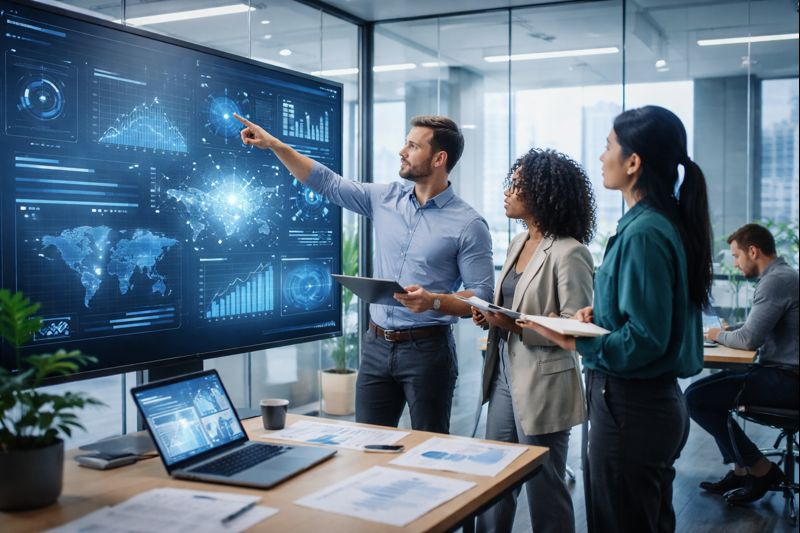
Office technology in 2026 looks very different from what most organizations relied on just a few years ago. The shift is not about adding more tools. It is about building connected systems that unify data, workflows, and decision-making across the entire business.
Enterprise resource planning, cloud platforms, no-code development, automation, e-commerce, data collection, and artificial intelligence are no longer separate conversations. They are converging into a single operational ecosystem that defines how work gets done.
Organizations that succeed in 2026 treat office technology as a strategic foundation. Those who fall behind often struggle with fragmented systems, delayed insights, and reactive decision-making. The difference lies in how well technology supports planning, execution, and continuous improvement.
ERP as the Digital Backbone of the Modern Office
Enterprise resource planning systems continue to evolve beyond accounting and back-office administration. In 2026, ERP serves as the central operating layer that connects finance, operations, inventory, projects, equipment, and customer activity, creating continuity across every core business function.
ERP platforms increasingly act as a single source of truth. They reduce duplicate data entry, eliminate reporting silos, and ensure every department operates with consistent information, improving visibility, coordination, and decision-making at both operational and leadership levels.
Resource Planning Becomes Predictive and Continuous
Resource planning is no longer limited to static forecasts created once per quarter. Modern ERP systems enable continuous planning across:
-
Workforce scheduling and utilization
-
Inventory and material requirements
-
Equipment capacity and availability
-
Budget allocation and cost controls
The biggest shift in 2026 is the move toward predictive resource planning. Systems analyze historical trends, live operational data, and external signals to surface risks and opportunities earlier.
Instead of reacting to shortages or overruns, teams receive early indicators that allow proactive adjustments. Resource planning becomes a living process that adapts as conditions change.
Cloud Enterprise as the Default Operating Model
loud enterprise platforms are no longer optional. By 2026, they are the default foundation for office technology, supporting faster decision making, broader system connectivity, and the flexibility required to respond to constant operational change.
Why Cloud First Matters More Than Ever
Cloud-based systems offer advantages that traditional infrastructure cannot match:
-
Rapid scalability without hardware investments
-
Continuous security updates and compliance improvements
-
Support for remote and hybrid teams
-
Faster deployment of new features and integrations
Hybrid cloud strategies are also becoming common. Organizations balance public cloud flexibility with private cloud control to meet performance, data residency, or regulatory requirements while maintaining operational consistency.
Cloud architecture enables ERP, analytics, automation, and AI tools to operate in real time. This makes the office more responsive, resilient, and adaptable to change as business demands evolve.
No-Code and Low-Code Redefine How Systems Are Built
Empowering Business Teams
By 2026, business users no longer wait in line for IT development cycles. Instead, they use no-code and low-code tools to build:
-
Custom workflows and approval chains
-
Data entry forms and validation rules
-
Internal dashboards and reports
-
Simple system integrations
These tools allow teams closest to the work to design solutions that reflect real processes. Development cycles shorten dramatically, and innovation happens closer to daily operations, enabling faster testing, refinement, and continuous improvement across departments.
Strong governance remains essential. Successful organizations establish standards that balance flexibility with data integrity, security, and long-term system stability.
E-commerce Becomes an Operational Core, Not Just a Channel
From Online Orders to End-to-End Execution
Modern ecommerce systems support:
-
Real-time inventory visibility
-
Dynamic pricing and customer-specific catalogs
-
Automated order fulfillment and invoicing
-
Integrated returns and customer service workflows
This integration is especially critical for B2B organizations. Buyers expect fast, transparent, and self-service experiences similar to consumer ecommerce.
When e-commerce connects directly to ERP systems, organizations reduce errors, speed fulfillment, and gain better insight into demand patterns.
Automation Becomes the Invisible Workforce
Automation quietly supports nearly every office function in 2026. Rather than dramatic system replacements, automation focuses on removing friction from everyday work, as 2025 industry surveys show more than 70 percent of organizations now automate at least one core business process to improve efficiency and consistency. 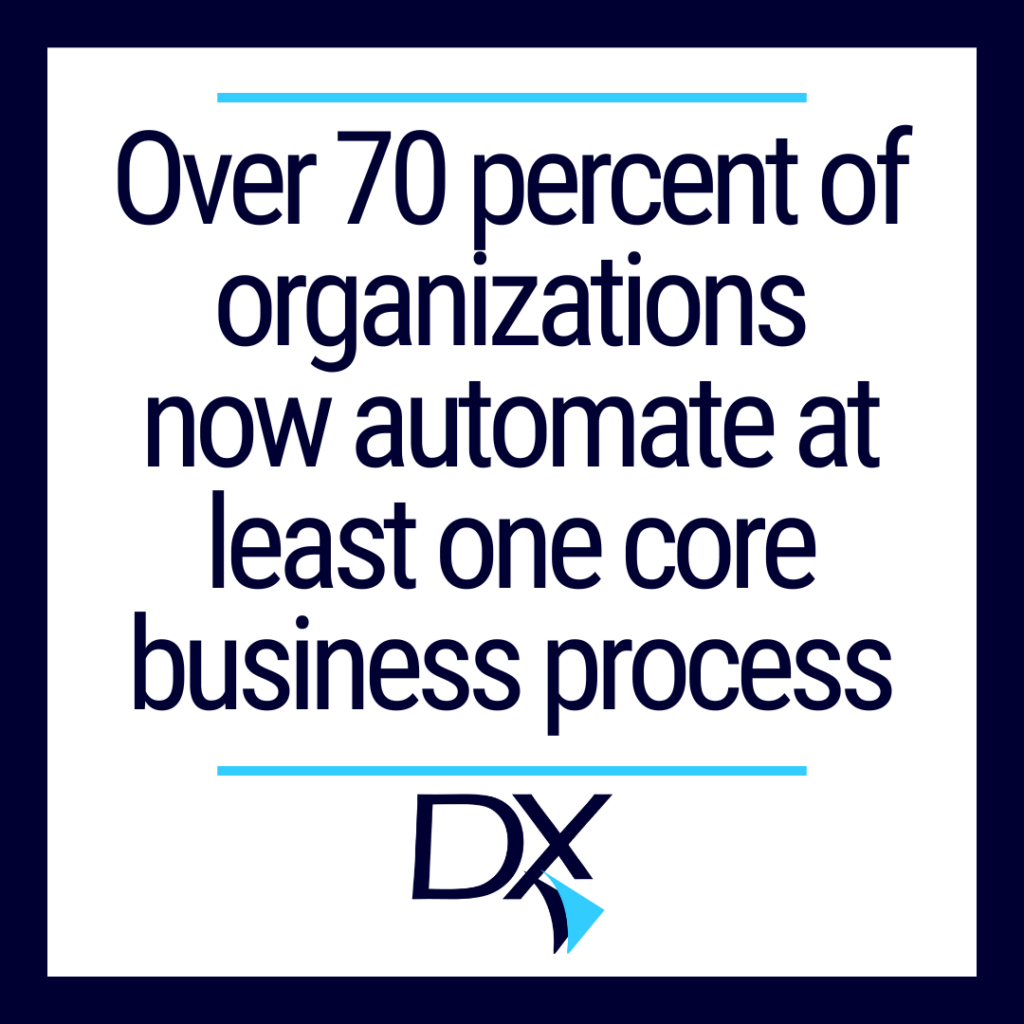
Smarter Office Automation
Automation now handles tasks such as:
-
Purchase order generation based on inventory thresholds
-
Invoice matching and reconciliation
-
Workflow routing for approvals and exceptions
-
Notifications triggered by operational events
These automations reduce manual effort and ensure consistency. Teams spend less time on repetitive work and more time analyzing results and improving processes.
The most effective automation strategies remain transparent. Employees understand what the system is doing and can intervene when judgment is required.
Data Collection Agents Drive Real-Time Awareness
Office technology in 2026 depends on continuous data collection across the organization, ensuring leaders and teams have accurate, timely insight into operations, performance trends, and emerging issues as they happen.
Data From the Edge to the Office
Modern businesses rely on data collection agents such as:
-
IoT sensors on equipment and facilities
-
Mobile tools for field, warehouse, and service teams
-
Integrated customer interaction tracking
-
Automated system and usage logs
This data feeds centralized platforms that provide real-time visibility into operations. Leaders identify bottlenecks faster, detect anomalies earlier, and make decisions based on current conditions instead of delayed reports.
The value lies in connecting data to business context, not simply collecting more of it.
Equipment Management Becomes Predictive and Strategic
Intelligent Asset Oversight
Modern equipment management systems provide:
-
Usage-based maintenance scheduling
-
Predictive failure detection
-
Integrated cost and depreciation tracking
-
Performance comparisons across locations
This shift reduces downtime and extends asset life. Equipment data informs planning decisions rather than serving as a historical record.
Equipment management becomes part of overall resource planning, ensuring assets align with operational goals.
Project Management Integrates With Core Operations
Project management tools no longer exist in isolation. In 2026, they will integrate directly with ERP, finance, and resource planning systems, creating shared visibility, tighter coordination, and more reliable execution across complex initiatives.
From Planning Tools to Execution Intelligence
Modern project management platforms deliver:
-
Real-time cost and budget tracking
-
Visibility into resource availability
-
Predictive alerts for schedule risks
-
Visual progress reporting tied to actual data
This integration ensures projects remain aligned with financial and operational realities. Leaders gain confidence that timelines and budgets reflect real conditions rather than assumptions.
AI Becomes the Intelligence Layer Across Office Technology
Artificial intelligence will no longer be experimental by 2026. It becomes an embedded intelligence layer across office systems, quietly enhancing planning, analysis, automation, and decision support without requiring constant human intervention.
AI Inside ERP and Resource Planning
AI enhances ERP systems by:
-
Improving demand forecasting accuracy
-
Identifying inefficiencies in labor and capacity usage
-
Detecting financial anomalies and trends
-
Recommending planning scenarios
By continuously analyzing historical patterns alongside real-time operational data, AI helps organizations anticipate constraints before they impact performance. AI does not replace human decision-making. Instead, it strengthens it by surfacing insights faster, highlighting risks earlier, and providing consistent analytical support that would be difficult to achieve through manual analysis alone.
Cloud-Based AI at Scale
Cloud infrastructure allows organizations to deploy AI without a large upfront investment. AI models continuously learn from new operational data, improving accuracy over time while adapting to changing business conditions across departments and workflows.
Cloud-based AI enables real-time processing, faster innovation cycles, and smoother updates without system disruption, giving organizations the flexibility to scale intelligence alongside growth, seasonal demand, evolving operational complexity, and expanding data volumes.
AI and Office Equipment Intelligence
AI interprets equipment data to:
-
Predict maintenance needs
-
Optimize usage and scheduling
-
Reduce energy consumption
-
Benchmark performance across sites
These capabilities lower costs and improve reliability without manual oversight, while also extending asset lifespan, reducing unexpected downtime, improving safety outcomes, and supporting more informed long-term capital planning decisions.
AI Agents and Knowledge Automation
AI-powered assistants increasingly support knowledge work by:
-
Answering operational questions using ERP data
-
Summarizing reports and dashboards
-
Automating documentation and approvals
In 2026, these agents act as always-on operational guides rather than simple chat tools. They reduce friction between systems by translating complex data into clear, role-specific insights.
Employees no longer need to navigate multiple dashboards or reports to find answers. Instead, they receive context-aware responses that reflect real-time conditions. As a result, teams spend less time searching for information and more time applying judgment, strategy, and collaboration to higher-value initiatives.
The Human Side of Office Technology
Technology alone does not drive success. Skills, mindset, and organizational culture remain just as critical as the systems themselves, shaping how tools are adopted, trusted, and used to drive meaningful, sustainable business outcomes.
Preparing Teams for 2026
Successful organizations invest intentionally in people, not just platforms. This includes:
-
Data literacy across departments
-
Clear process ownership and accountability
-
Continuous improvement practices tied to measurable outcomes
As systems become more connected and automated, employees increasingly act as system designers and process stewards, not just end users. Teams that understand how data flows between departments can identify inefficiencies, prevent errors, and improve workflows before problems escalate. When people trust the data and understand the tools, decision-making becomes faster, more confident, and more aligned with business goals.
Looking Ahead
Office technology in 2026 is defined by connection, intelligence, and adaptability. ERP anchors the ecosystem. Cloud platforms provide flexibility. No-code tools empower teams. Automation handles routine work. AI turns data into insight, creating a continuously learning operational environment.
Organizations that align these technologies around clear processes and skilled teams position themselves to respond to change with confidence. The future office is not just more digital. It is more aware, more responsive, and more capable of sustaining growth in an increasingly complex business landscape.